
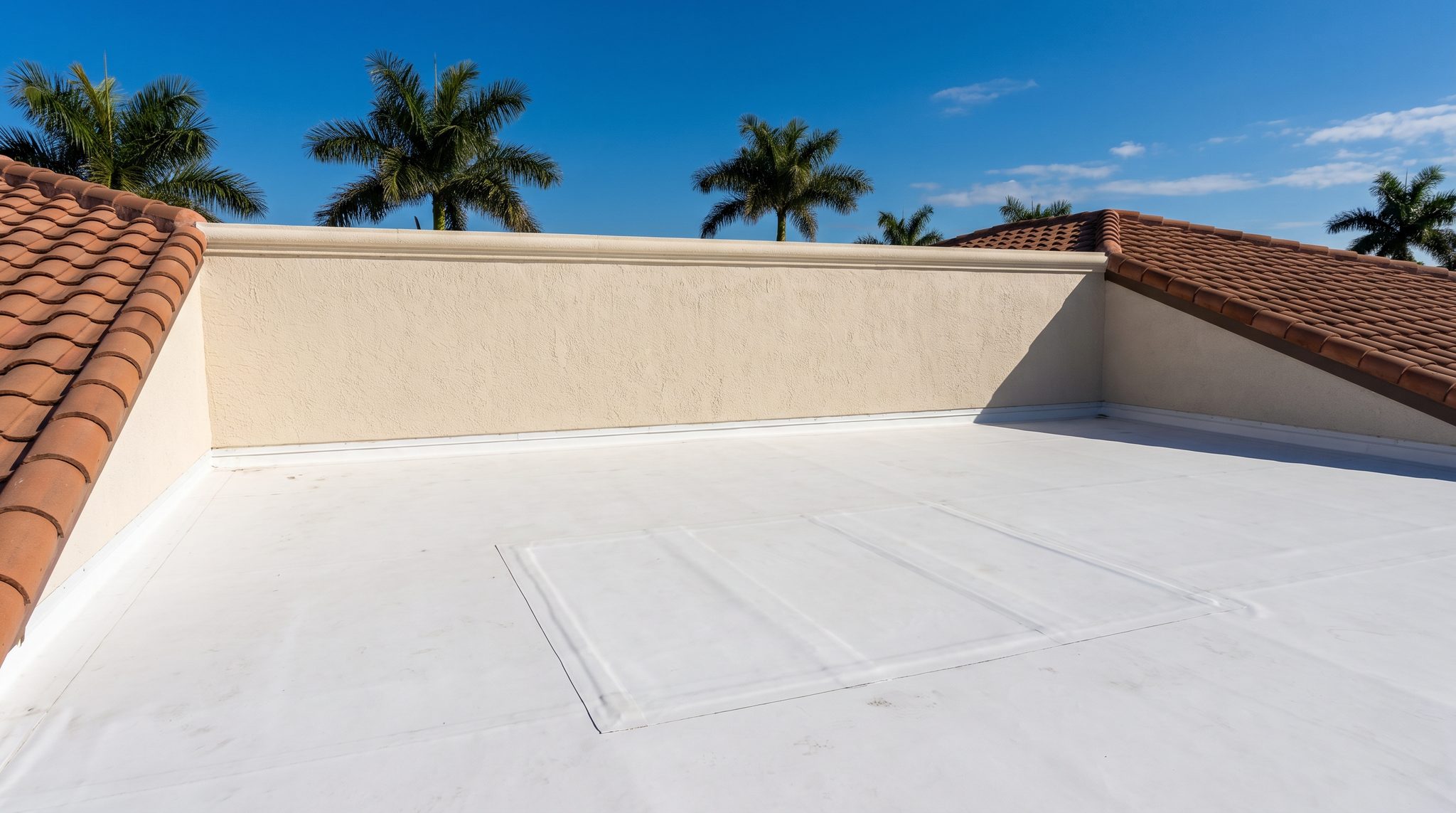
Very few Boca Raton houses are entirely flat, and that is exactly why flat roof repair here is its own discipline. The typical job is a low-slope section hidden behind a tile parapet — a rear addition, a screened enclosure, a garage, a flat deck over a Florida room — tied into a sloped tile field. Almost every leak we are called to on these roofs is at the tie-in, the parapet wall, or a penetration, not out in the middle of the membrane.
The tile-to-flat tie-in is where Boca roofs leak
A Mediterranean Revival elevation with a barrel tile front and a flat rear section has a transition detail doing a lot of work: the flat membrane has to run up under the tile field or up a wall and be counterflashed properly. Done well it disappears. Done as an afterthought — membrane terminated with mastic and a bead of caulk — it fails in a few seasons, and the water shows up inside the addition rather than at the transition.
We open the termination rather than reseal it. That means cutting back to sound membrane, rebuilding the base flashing up the wall to the height code requires, and setting proper counterflashing or a reglet instead of surface sealant. It is more work than a mastic patch and it is the only version that survives a summer of afternoon storms.
Parapets deserve the same treatment. Stucco parapets on Boca additions crack, and a cracked parapet takes water behind the membrane where no amount of roof-side patching will reach it. If that is what we find we say so, because the fix is partly a wall repair.
Ponding, drainage and afternoon storms
Low slope is not no slope, but plenty of Boca flat sections drain badly — a scupper set too high, a deck that has deflected over a long span, an added air handler platform interrupting flow. South Florida wet-season rainfall arrives faster than a compromised drainage path can clear it, and standing water finds every marginal seam and fastener.
Before repairing membrane we look at where the water goes. Sometimes the honest fix is a tapered insulation crickets or a relocated scupper rather than more membrane. Repairing a seam at the low point of a permanent puddle just relocates the next leak.
Ponding also reads badly on any inspection or resale report, and it accelerates UV and biological attack on the surface. Getting the water off the roof is the repair that makes the other repairs last.
Penetrations, pitch pans and coastal hardware
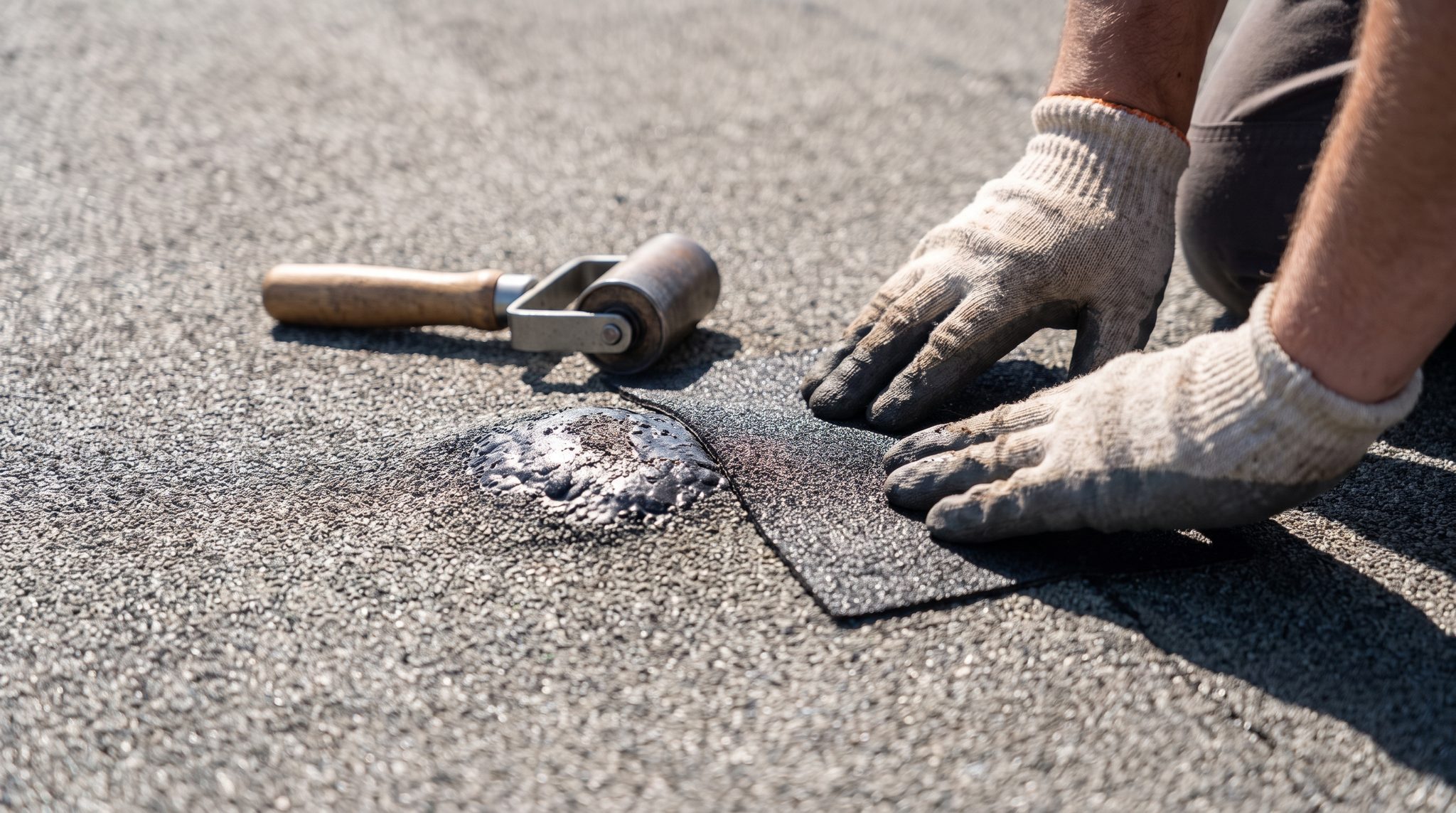
Flat sections carry the mechanical clutter: condenser stands, plumbing vents, electrical whips, satellite mounts, sometimes a pool heater line. Each of those is a hole in the waterproofing, and pitch pans filled once with a shrinking sealant are among the most common leak sources we find on Boca low-slope roofs.
We rebuild penetration details with proper flashing where the geometry allows, and where a pitch pan genuinely is the right solution we set it with a non-shrinking two-part fill rather than topping up caulk. On the coastal side of the city, near Royal Palm Yacht & Country Club and the streets east of Federal Highway, fastener and pan metal choice matters as much as the sealant: chloride-driven corrosion is what opens these details in the first place.
Curbed equipment is worth raising when we are already there. An air handler platform sitting directly on the membrane cannot be maintained without damaging the roof, and lifting it onto a properly flashed curb turns a recurring leak into a solved one.
Working around HOA rules and county inspection
Torch-applied modified bitumen and hot asphalt come with real constraints inside gated communities. Broken Sound and Woodfield have limits on work hours, staging and equipment on site, and neighbours notice smoke and kettles. Where a community or a roof geometry makes torch work inappropriate we use self-adhered or cold-applied systems, which are a legitimate spec, not a compromise.
Permitting runs through Palm Beach County and the City of Boca Raton. As on tile, there is a repair-area threshold above which a low-slope section has to be brought up to current code rather than patched, and low-slope sections hit that line sooner than people expect because the sections are small — a third of a small flat roof is a large percentage of it.
We assess that percentage before quoting. If a repair is going to trip the threshold anyway, you deserve to know that the sensible comparison is against replacing the section, not against another patch.
When a coating or a replacement is the better answer
A repair is the right call for local failures on a membrane with life left in it. Where the surface is chalked and crazed across the whole section but the substrate is dry and sound, a fluid-applied system is often better value than repeated patching — that is the subject of our flat roof coating work in Boca Raton.
Where the insulation is saturated, the deck is soft, or seams are opening in several places at once, no coating and no patch will fix a wet roof. Water trapped in the assembly keeps working whatever goes on top of it, and the section needs to come off.
We document what we find either way, with dated photographs and moisture observations, so the recommendation is auditable. If you want the condition established first, start with a roof evaluation in Boca Raton, or read the material detail on our flat roof repair service page.
Working outside Boca Raton, or want the material detail without the local context? Read our flat roof repair across Palm Beach, Broward and Miami-Dade, or see everything we cover in roofing in Boca Raton.