
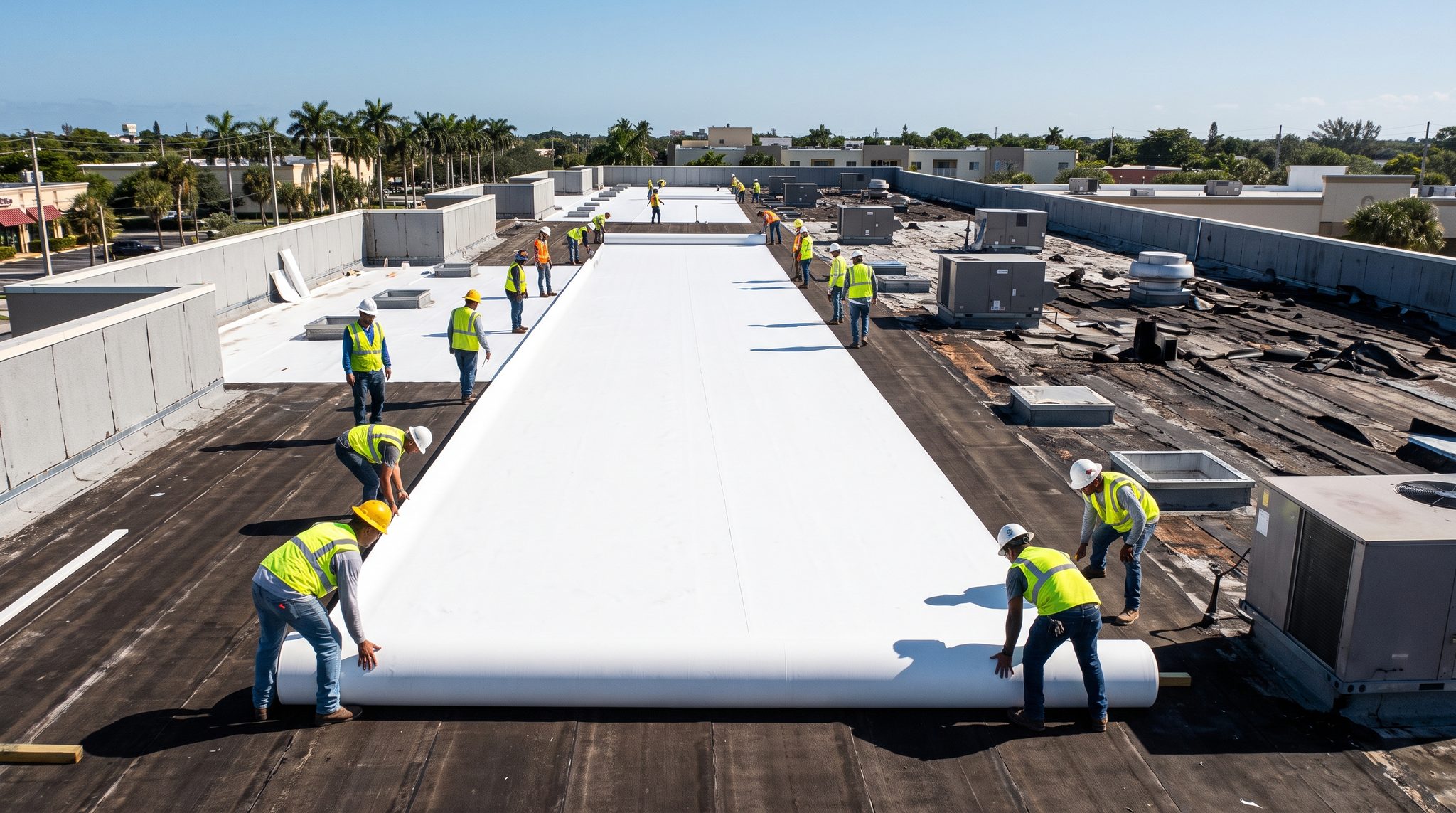
A flat re-roof replaces a low-slope system that has run out of service life — the membrane, the insulation where it is wet, the flashings, the drains and the terminations. Low-slope roofs in South Florida fail differently from pitched ones: they hold water instead of shedding it, so the job is as much about drainage and detailing as it is about the membrane you roll out.
Substrate and tear-off: what you are actually working over
Low-slope decks around here are usually concrete, lightweight insulating concrete, or plywood over framing, and each behaves differently. Concrete decks hold moisture and require the right primer and attachment; lightweight decks can be saturated below a failed membrane; plywood decks can be soft around drains and parapets where water has stood for years.
We core or probe suspect areas before pricing so the tear-off scope is known rather than discovered. Where insulation is wet it comes out — leaving saturated board under a new membrane traps that water permanently and blisters the new roof from below. Where the existing system is sound and thin enough, a recover over a cover board is sometimes permissible, but only a roof that has not already been recovered qualifies.
Fixing the drainage while the roof is open
Most flat roofs we replace failed at a low spot, not in the field. Ponding accelerates membrane aging, loads the deck, and finds every seam. A re-roof is the only practical opportunity to correct it: tapered insulation to build positive slope toward drains, crickets between drains and behind curbs, and secondary overflow scuppers where the code requires them.
Drains themselves get new clamping rings and target sumps, and scupper boxes get rebuilt rather than resealed. If a roof has been patched at the same drain three times, the drain detail is the problem.

Choosing the membrane
Single-ply TPO is the default for reflective, mechanically-attached or adhered work on commercial decks, and its heat-welded seams are strong and inspectable. Modified bitumen — torch-applied or self-adhered — suits smaller residential low-slope areas, roofs with heavy foot traffic, and tie-ins to tile decks. Traditional built-up work is still specified where a multi-ply asphalt system is the right answer; see hot mop roofing for how that method is installed and where it fits.
Where the existing membrane is aging but not failed, and the deck below is dry, a fluid-applied restoration can extend service life instead of replacing it — that is a flat roof coating scope, and it is a genuinely different job from a re-roof.
Terminations, penetrations and wind uplift
Flat roofs fail at their edges. Perimeter edge metal has to be tested and approved for the design wind pressures, base flashings need to run high enough up parapets and curbs, and every A/C stand, vent and conduit penetration needs a proper flashed detail rather than a mastic patch.
Attachment density increases at the perimeter and corners because uplift pressure does. In HVHZ counties the whole assembly — deck, insulation, membrane, edge metal — is approved together under a Notice of Acceptance, and substituting one component out of that assembly invalidates it.
What to expect while work is underway
Low-slope tear-off is a hot, loud job with equipment on the roof, and occupied buildings will notice it. Where the roof serves offices or units below, we sequence sections so no occupied area is left uncovered, and we schedule odour-producing work around business hours where the building requires it.
If the roof is already leaking into the building, tell us where. Interior damage locations help us map the failure and prioritise which section to tear off first. Isolated leaks on an otherwise healthy roof are a flat roof repair, not a re-roof.